The Polish avant-garde: New Pop at Gelleria DAP, Warsaw
Founded in 1979 against the backdrop of communist Poland, the art group Łódź Kaliska now finds a home at Galeria DAP in Warsaw, with its work featured in ‘New Pop’, an exhibition organised by Galerie Kantor Sztuki.

As of 1 September 2026, Warsaw hosts a must-see exhibition with the introduction of ‘New Pop’ at Galeria DAP. A short walk from the Presidential Palace of Warsaw, away from the golden-lit buildings of the Old Town, lies a hidden gem representing Poland’s history. Curated by Michalina Franasik, ‘New Pop’ brings the work of Łódź Kaliska together with that of fashion designer Patrycja Plesiak to offer an insightful look into Poland’s history.

Łódź Kaliska, founded in 1979, is a Polish avant-garde group known for its provocative photography in the late communist period. For over 40 years, Łódź Kaliska has used art to challenge authority and represent a changing Poland. Born out of the group’s expulsion from a photography gathering in Darłowo, the original members included Marek Janiak, Andrzej Kwietniewski, Adam Rzepecki, Andrzej Świetlik and Andrzej Wielogórski (Makary). In November 2025, Łódź Kaliska’s Andrzej Świetlik passed away, leaving the group currently composed of Marek Janiak and Adam Rzepecki.

The curation by Michalina Franasik makes excellent use of the space at Galeria DAP. ‘New Pop’ opens with Stefan i majonez (Stefan and Mayonnaise, 2010), before moving on to Stefan i majonez. Sezon II (Stefan and Mayonnaise. Season II, 2025), and concludes with Tryumf (Triumph, 2002) and Gorsety (Corsets, 2003), Łódź Kaliska’s earliest works in the exhibition. Although not chronological, the arrangement encourages visitors to consider the progression of Łódź Kaliska’s practice, while making effective use of the gallery space.

The exhibition challenges meanings of identity, class and artistic disruption. Eagle-eyed fans of Polish literature might be delighted to recognise the face of Stefan Żeromski, a prominent Polish novelist from the turn of the 20th century, who takes centre stage in Łódź Kaliska’s Stefan i Majonez (Stefan and Mayonnaise).
Żeromski, who wrote major works of Polish literature such as Przedwiośnie (The Coming Spring) and Popioły (Ashes), is reimagined in Stefan i Majonez (Stefan and Mayonnaise) and comes alive under bright, Andy Warhol-esque colours. In the artwork, Żeromski is paired with a jar of ordinary Polish mayonnaise, an object instantly recognisable in Polish culture. The juxtaposition is equal parts intriguing and playful.
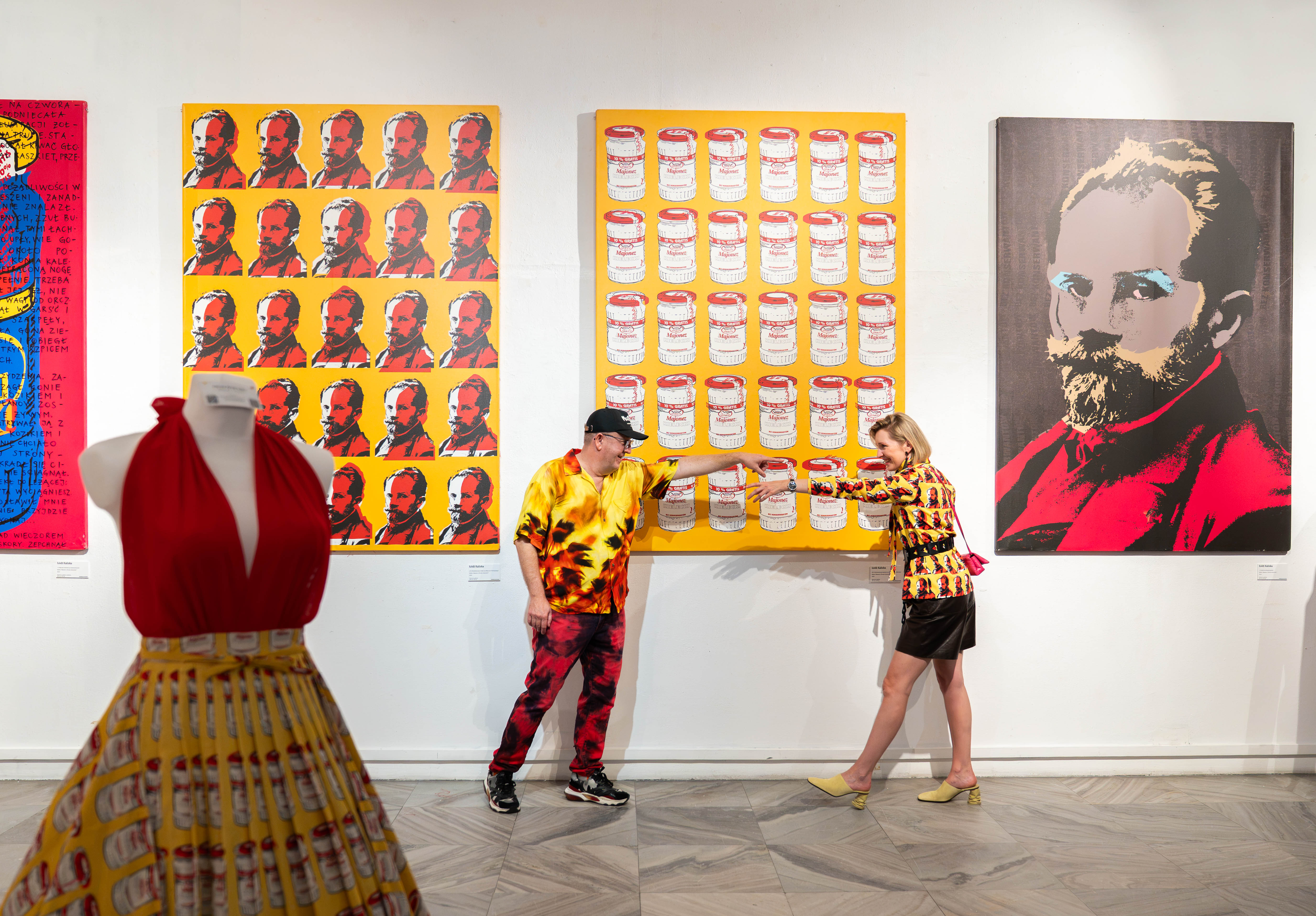
Stefan i Majonez. Sezon II (Stefan and Mayonnaise. Season II) takes this further. Developed in 2025, and among the last pieces of work completed before the death of Andrzej Świetlik, Season II pokes fun at capitalism and consumer culture. Noticeably less bright in its use of colour but richer in its critique of culture, the series is a fascinating study of Polish identity, as well as the contemporary landscape of consumer culture in 2026. With its critique, Stefan i Majonez. Sezon II (Stefan and Mayonnaise. Season II) is a standout work in the exhibition. The playful, tongue-in-cheek artistic style of Łódź Kaliska is prevalent throughout the exhibition, with titles such as Temu Stefan shining through.
%20copy.jpg)
Notable designer Patrycja Plesiak, who previously featured her collections in the Carrousel du Louvre Runway Show, transforms Łódź Kaliska’s prints into moving pieces of art. Plesiak leans into the bright colours and prints of Łódź Kaliska’s artwork, enriching the art already filling the room.
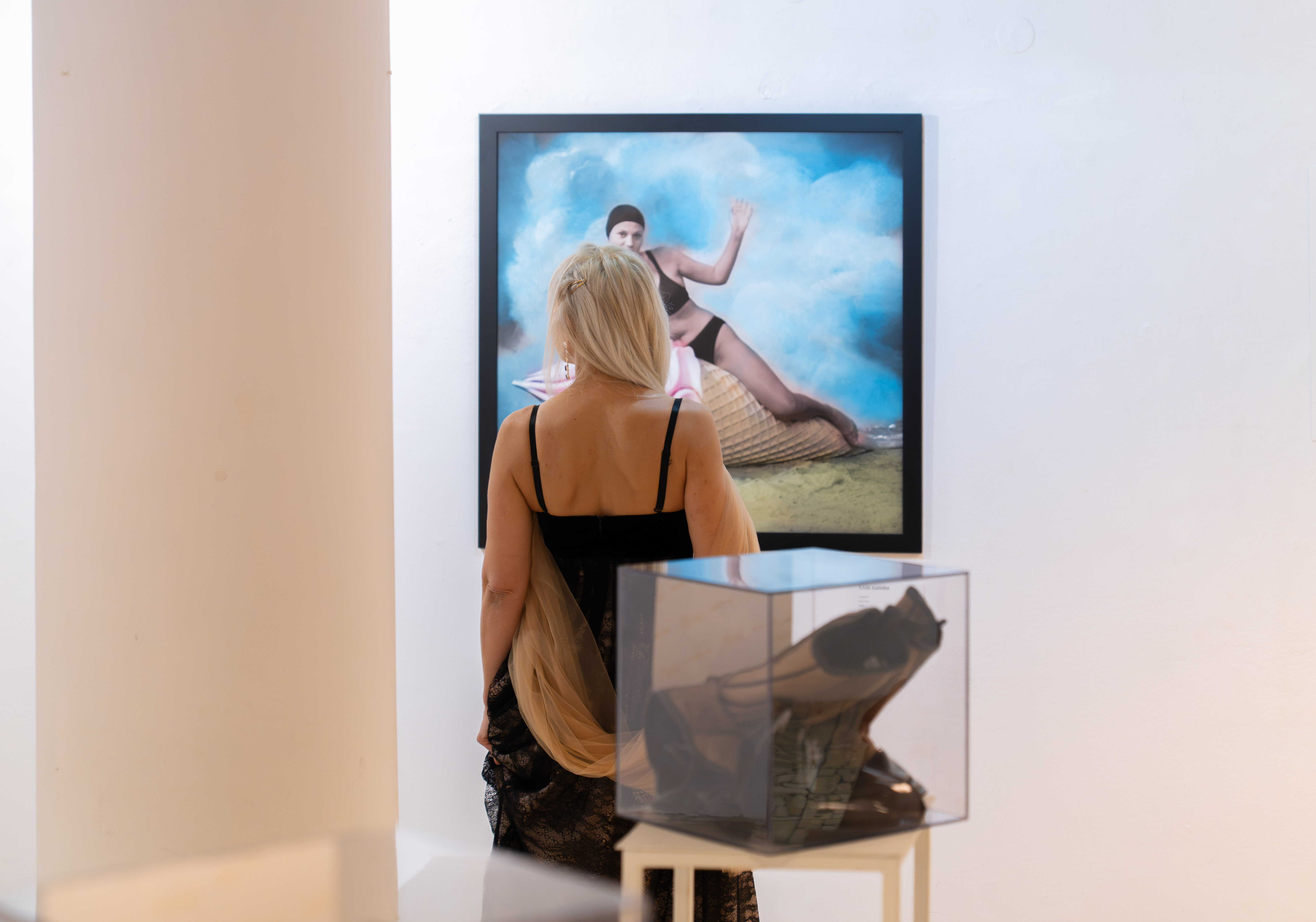
Tryumf (Triumph) takes the audience back to 2002, when Łódź Kaliska created a series of four photographs featuring four women, each with a different identity and perspective on life in Poland. An accompanying paragraph outlines each woman’s hopes for the future as she poses on top of a large ice cream. A celebration of Polish identity, Tryumf (Triumph) uses the playful setting of models posing on a giant ice cream by the sea to explore ideas of identity and nationalism.
-1.jpg)
Perhaps the most provocative and starkly different part of the exhibition is the set of photographs titled Gorsety (Corsets). Vastly different from later works such as Stefan i Majonez (Stefan and Mayonnaise), Gorsety (Corsets), made in 2003, features models dressed in corsets posing with one another. The original corsets used in the photographs are also displayed around the room.
It is rare for an exhibition to capture a country’s changing culture over so many decades, but having stayed together for over 40 years, Łódź Kaliska is a rarity. ‘New Pop’ is a must-see exhibition for visitors interested in Polish history and culture, sure to leave you curious and inspired.
‘New Pop’ at Galeria DAP is open to visitors until 18 October 2026.